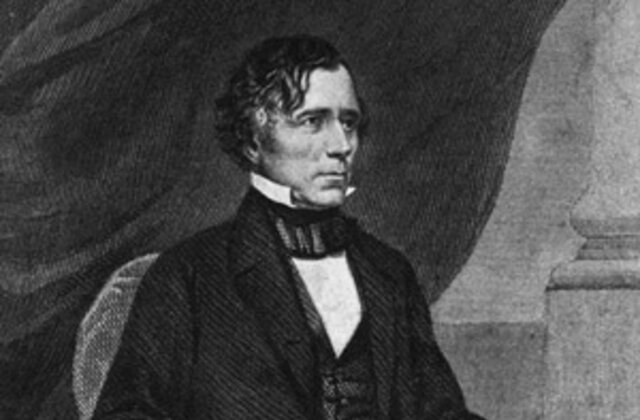
molecular-designs.com – Franklin Pierce, the 14th President of the United States, served from 1853 to 1857 during a turbulent period in the nation’s history. Known for his strong support of the Kansas-Nebraska Act, Pierce’s presidency is often remembered for his inability to address the rising tensions between the North and South over slavery. His administration struggled with divisive issues, including territorial expansion, the enforcement of the Fugitive Slave Law, and growing sectionalism. Although he came into office with great political promise, Pierce’s presidency ended in disillusionment and failure, and he was largely sidelined in the political landscape that followed.
Early Life and Political Career
Franklin Pierce was born on November 23, 1804, in Hillsborough, New Hampshire, into a well-established political family. His father, Benjamin Pierce, was a Revolutionary War veteran and later served as governor of New Hampshire. Franklin was an intelligent and ambitious student, but his early life was marked by personal challenges, including the loss of his brother to a hunting accident.
Pierce attended Bowdoin College in Maine, where he developed a passion for law and politics. After graduating in 1824, he studied law and entered the legal profession in New Hampshire. His political career began in the 1820s when he was elected to the New Hampshire State Legislature. Pierce’s early political alignments were with the Democratic-Republican Party, and by the 1830s, he was a staunch supporter of Andrew Jackson and his political ideology.
Pierce’s political career advanced with his election to the U.S. House of Representatives in 1833, where he served until 1837. He later returned to New Hampshire politics and was elected as a U.S. Senator in 1837. However, Pierce’s political career was marked by inconsistency, and after losing his Senate seat in 1842, he became disillusioned with national politics for a brief period.
During the Mexican-American War, Pierce served as a brigadier general, earning recognition for his leadership in the conflict. His military service was one of the key factors that helped him regain prominence within the Democratic Party in the years leading up to the presidential election of 1852.
The 1852 Election: Pierce’s Path to the Presidency
In 1852, Franklin Pierce was unexpectedly nominated by the Democratic Party to run for president. The Democratic convention was divided over the issue of slavery and the nation’s growing sectional tensions. Pierce, a relative political outsider with a background in military service, was seen as a moderate candidate who could unite factions within the party. His nomination was a response to the growing unpopularity of President Millard Fillmore and the collapse of the Whig Party.
Pierce ran against Winfield Scott, the Whig candidate, who was a hero of the Mexican-American War, and John P. Hale, representing the Free Soil Party. The election was largely focused on the issue of westward expansion and the future of slavery in the new territories. Pierce’s appeal to Southern Democrats, his strong support of territorial expansion, and his promise of national unity helped him secure a decisive victory. He won with 50.9% of the popular vote and 254 electoral votes, defeating Scott by a wide margin.
Pierce’s Presidency: A Struggle with Sectionalism
Franklin Pierce’s presidency began with high expectations, but he was quickly confronted with the growing sectional tensions that would ultimately lead to the Civil War. His inability to address the issue of slavery in a way that satisfied both the North and South led to increasing divisions within the nation.
- The Kansas-Nebraska Act: Pierce’s most significant and controversial achievement was his support for the Kansas-Nebraska Act of 1854, which was introduced by Senator Stephen A. Douglas. The act created two new territories, Kansas and Nebraska, and allowed the settlers in those territories to determine whether they would allow slavery through the principle of popular sovereignty. This legislation effectively repealed the Missouri Compromise of 1820, which had prohibited slavery in most of the northern territories.
While the Kansas-Nebraska Act was intended to promote national unity and facilitate the settlement of the western territories, it sparked intense controversy. In the North, abolitionists viewed it as a betrayal of the Missouri Compromise and a threat to the spread of slavery. In the South, many saw it as a necessary expansion of their way of life. The act led to violent clashes between pro-slavery and anti-slavery settlers in Kansas, an episode known as “Bleeding Kansas.” Pierce’s support for the act alienated many in the North and undermined his standing with both pro-slavery and anti-slavery factions.
- The Fugitive Slave Law: Pierce’s presidency also coincided with the enforcement of the Fugitive Slave Law (part of the Compromise of 1850), which required the return of escaped slaves to their owners. The law was deeply unpopular in the North, where it was seen as an infringement on states’ rights and personal liberty. Pierce supported the law’s enforcement, which further damaged his political credibility in the North and increased tensions between the sections.
- Foreign Affairs and Expansion: In foreign policy, Pierce sought to expand American influence, particularly in Latin America and Asia. He sought to acquire new territories, including the Gadsden Purchase of land from Mexico in 1853, which facilitated the construction of a southern transcontinental railroad. Pierce’s administration also attempted to negotiate the Ostend Manifesto, which sought to justify the U.S. acquisition of Cuba, but this effort was met with strong opposition from the North and ultimately abandoned.
Pierce’s administration also dealt with increasing tensions between the United States and Great Britain over issues such as the Central American isthmus and the expansion of slavery into foreign territories. His handling of foreign affairs was generally viewed as ineffective, and he failed to build meaningful diplomatic successes.
Pierce’s Declining Popularity and End of Presidency
As Pierce’s presidency progressed, his popularity dwindled, largely due to his inability to effectively manage the issue of slavery and growing sectional conflict. His support for the Kansas-Nebraska Act and the Fugitive Slave Law deeply divided the nation, and his inability to prevent violence in Kansas left him with little political capital.
In 1856, Pierce’s party, the Democrats, turned to other leadership options, and Pierce was not re-nominated for a second term. The Republican Party had been formed during this period as an anti-slavery coalition, and it quickly gained momentum, particularly in the Northern states. Pierce’s political career essentially ended after his presidency, and he withdrew from public life.
Post-Presidency and Legacy
After leaving office, Franklin Pierce largely retreated from the public eye. He retired to his home in New Hampshire and remained largely uninvolved in politics. In the years following his presidency, Pierce’s reputation continued to suffer due to his handling of the sectional crisis and his support for pro-slavery policies.
Pierce’s legacy is often viewed negatively by historians. His presidency is marked by a failure to address the nation’s deepening divisions over slavery, and his support for policies like the Kansas-Nebraska Act and the Fugitive Slave Law helped inflame tensions that ultimately led to the Civil War. While he was well-intentioned in seeking to preserve the Union, his actions are seen as contributing to the collapse of national unity. Franklin Pierce passed away on October 8, 1869, at the age of 64.
Conclusion
Franklin Pierce’s presidency is remembered as one of the most divisive and tumultuous periods in American history. Despite coming to power with the support of a unified Democratic Party, Pierce’s inability to effectively navigate the issue of slavery and his support for policies that alienated both the North and South ultimately contributed to the growing sectional crisis. His presidency failed to prevent the deepening divide between the North and South, and his legacy is overshadowed by the events that followed, including the Civil War.